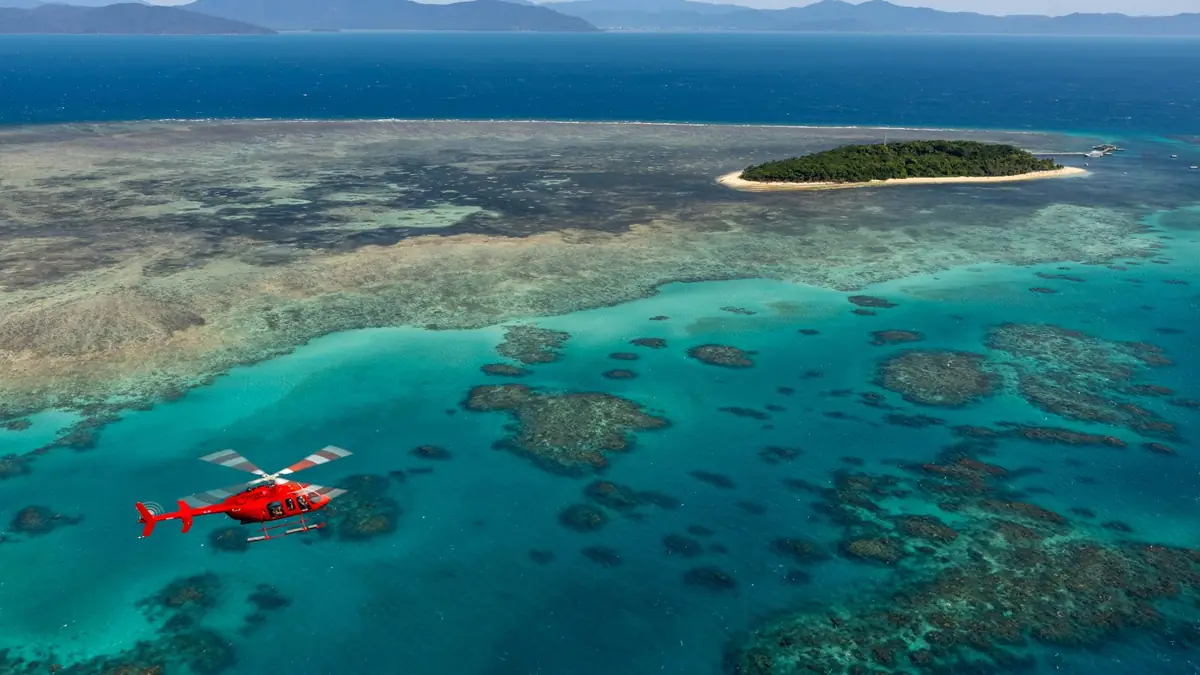
There is a version of the Great Barrier Reef that most visitors never see — not from a crowded catamaran deck, but from 1,000 feet above, in a private helicopter with nobody else on board.
The Great Barrier Reef stretches 2,300 kilometres along Australia's northeast coast — the largest living structure on Earth, visible even from space. Most visitors experience a small fraction of it, usually a single pontoon reachable by day-boat from Cairns or Port Douglas. A private helicopter changes the entire equation.
What You Actually See
From altitude, the reef reveals its true scale: coral bommies scattered like galaxies across water that shifts from deep cobalt to impossible turquoise within metres. Heart Reef — the famous naturally heart-shaped coral formation — is only properly visible from the air, and remains one of the most photographed 90 seconds in Australian tourism for good reason.
Most private charters combine the flight with a landing — either on a sand cay like Green Island, or directly onto a pontoon for private snorkelling away from the day-tripper crowds.
What It Costs
Private helicopter reef experiences in Queensland typically range from AUD $600 to $2,000+ per person, depending on flight duration, whether a landing is included, and group size. A fully private charter (rather than a shared scenic flight) sits at the top of that range — but for the kind of journey we design, shared flights rarely make sense.
The Best Departure Points
- Cairns — the widest range of operators and the shortest flight time to the outer reef
- Port Douglas — quieter, closer to the Daintree, ideal if combining reef and rainforest in one trip
- Hamilton Island / the Whitsundays — best for combining the reef with Heart Reef and Whitehaven Beach in a single flight
How We Build This In
We rarely book a reef flight as a standalone activity. The strongest itineraries pair it with 2–3 nights in the Daintree beforehand — rainforest to reef in one seamless movement, exactly the contrast that makes tropical Queensland so extraordinary. Timing matters too: mid-morning flights typically offer the clearest water and best light for photography.